Showing posts with label education. Show all posts

Monday, May 11, 2015

We Do Not Know How Children Learn. (So how do we teach?)

The Tree of Knowledge


A while back I wrote a post on how children learn. Or rather, our ignorance as to how children learn. Because no one really understands how it happens (and it does...happens). One thing we do know: learning cannot be coerced.

As the old saying goes: you can bring a horse to water, but you cannot make it drink. In the same way, we can bring a child to the lip of the “Pierian spring” but we cannot make her “drink deep.” We cannot force a child to learn.

Because the child has free will; the child is a person.

This is the first principle of Charlotte Mason’s philosophy of education. But another of her principles is equally important. It is that the child is equipped, suited, in fact, created to learn.

For the mind of a child is “a spiritual organism, with an appetite for knowledge.” And knowledge is “its proper diet.”

I think sometimes it would be helpful for us to remember that story by Kipling about the Elephant’s Child, who was full of “ ‘satiable curiosity.” Or we could just recall the four-year-old living in our own home. Elephants’ children, and human children also, are hungry, ravenous, starving for knowledge. They want to know why, where, how, when, what. They want to hear stories. They want to look at pictures. They want to know what is in the dirt. They want to know how to draw a nose. They want to know what sound the vase makes if you drop it down the stairs. You don’t have to “teach” a small child. You merely have to let them play, let look at books, talk to them, read to them, answer their questions. They are hungry and knowledge is their “proper diet.”

According to Charlotte Mason, this hunger is the first tool of a good educator. It means that the educator doesn’t have to resort to those commonly used tools of education which encroach upon the child’s free will, namely “fear, love, suggestion, influence or undue play upon natural desire.” It means you don’t HAVE to threaten or cajole with the promise of reward or penalty, you don’t have to give grades (gasp!). The child will want to know what kind of animals lives in Kenya/what happens at the end of the story/how Monet painted the water-lilies even without the threat/promise of grades.
In fact, grades can distract/dilute this natural hunger. The child begins to think she should learn about poetry/history/etc.  so she can get a grade, rather than because these things are worth knowing. The natural hunger is compromised. Sometimes it is lost altogether.   

This might be as good a time as any for me to say this: Charlotte Mason was not a proponent of “unschooling.” I am not a proponent of unschooling. Charlotte Mason advocated for a broad and rigorous curriculum. She expected excellence from even the youngest pupils. She expected her students to perform tasks with “perfect execution.”

But how can an educator expect these things (and get them!) without the use of the above listed forbidden tools (fear, love, suggestion…play upon natural desires), without grades, bribes, threats, etc?

As I suggest above, the natural hunger for knowledge does much of the work—if left intact.

But there are, according to Mason, three legitimate “instruments of education” available to the educator. These are:

1. Atmosphere or Environment

2. Discipline or Habit

and

3. The Presentation of Living Ideas
    

In the next few weeks I will try to explore each of these "instruments," and try to understand how I might implement them in my own home-life and home-school. 

Thursday, March 5, 2015

No one knows how children learn.


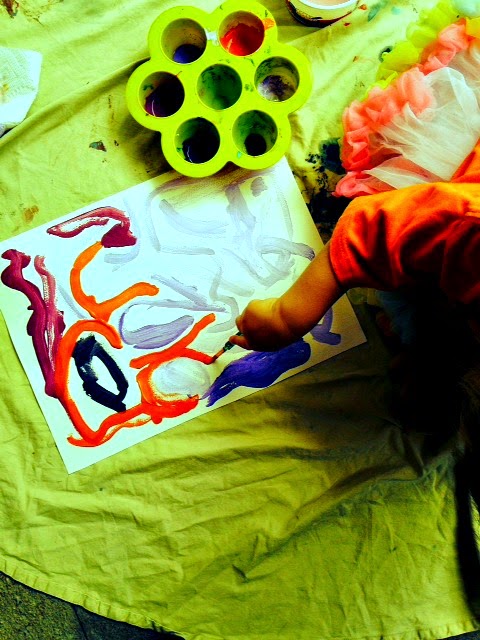
Don't be alarmed. These pictures were taken in the Fall. It is still winter here too.


No one knows how children learn.

I have always found it beautiful that the first thing a child learns, the first thing that he sees, hears, touches, knows outside himself is his mother. He sees her, and he recognizes--- what? his own body, his home, his source, and—surely!—unmediated, unadulterated, unconditional love.

That first learning is a deep mystery. And subsequent learning is an extension of the first. The child looks, reaches out with curiosity and wonder, and finds something outside himself, other than himself, but also something gloriously native: something he recognizes, a world that speaks of beauty and of—could it be?—love?

This is all mysterious and beyond our control and comprehension.

Let me repeat: beyond our control.

Because no one knows how children learn.

This is a truth that all teachers and all parents know, or soon find out. And as parent who also hopes to home school my kids, I think it is essential that I learn the lesson early and well.

It is tempting to think, as one carefully prepares ones’ curriculum, that by controlling the texts, the methods, the timing, etc. of your child’s education, you are actually controlling their education. You might be tempted to think, in fact, that *you* are educating them. But the best books, the best plan, the best theory, won’t ensure that your child will learn anything. Because learning is mysterious. No one knows how children learn.

Again and again I hear stories from home-school moms. They always go something like this: “It was the middle of winter and I had just had (baby number 3, 5, 10) and half of the household had the stomach flu. I hadn’t done any lessons for a month. The kids had been wearing the same pjs for days.  It was an epically horrible week. A week of home-school (and life in general) FAIL. And you know what, that was the week my daughter learned to read.”

It’s not that all the phonics, the letter games, the reading out loud, all that stuff—it’s not as if it didn’t matter. It did. These were the material and the tools of learning. These are the things we can offer to our children. But the learning—the learning itself—we cannot force that, require that, manufacture that.

This must be the most humbling and the most liberating fact for educators to grasp. Humbling (humiliating even) because we must learn that all our efforts, all our plans and intentions, all our theory, count for very little in the end. Because no one knows how children learn. Liberating because the child (our child!) does learn—often in spite our teaching.

All this means that the teacher must learn to let go, relinquish our control (which is in truth no real control) over the learning process.


Now for my confession. This is a very difficult principle for me to accept. Naturally I am a perfectionist and a control freak. I hold myself (and everyone else) to impossibly high standards. When I let this tendency reign, my life is, for obvious reasons, a misery. Because this is my natural inclination, and because I recognize it as a fault, I am constantly trying to avail myself of the wisdom which comes from parenting styles/philosophies that are in direct opposition to these tendencies. Thus I believe firmly in hours of unsupervised play, in dirty children playing unattended outside, etc. etc. (This does not mean, by the way, that I don’t believe in discipline, but that’s a topic for another post…)

And when it comes to homeschooling, I am most attracted to methods and curricula that give the greatest responsibility back to the child, and require the instructor to step back and away.

This is why I am attracted to the methods and writings of Charlotte Mason.

Mason’s first principle of education is that “children are born persons.” What does this mean? It means that a child is not a blank slate (to be written upon by careful teachers), or an empty bottle (to be filled by conscientious educators). Children are *persons,* with a will, an intellect, a personality, and a choice.

Persons are mysterious. Persons must be respected.

If we accept this fact then we must act (and teach) accordingly. We must not manipulate a person (even a child). We must not “encroach” upon their free will.

According to Mason the learning process must never “be encroached upon through use of fear or love, suggestion or influence, or upon undue play upon natural desire.”

Now if your education was anything like mine, these “tools” were used every day. In fact, it seems to me, that rarely were any other tools used. Desire for praise, fear of chastisement, desire for good grades, fear of bad grades.  Love of a teacher, love of peers, fear of teacher, fear of peers.
Could this be why I don’t remember much of what I “learned” in school? Because, so often, I was not—free?


So if we cannot use these tools, what can we use to help our children learn? Is the teacher useless? Is education divorced from the work of the educator? Is the only option some kind of radical “unschooling?”

Of course not. Surely this is not true.

The old adage tells us: you can bring a horse to water, but you can’t make it drink.

In the same way we can’t make our children “drink”—or learn. But we can, in fact we must, bring them to the water.


So how do we do this?

Friday, September 12, 2014

Back to School


The last post was a bit much, I know.  “It took you long enough to get around to it,” I hear you say. “You asked one little question and yet it took you a good 1300 words to establish one conclusion. Couldn't you have skipped all that stuff in the middle?“

And I apologize for this extended meditation. But people, I find, sometimes balk at Catholics who quote pat answers from the Baltimore Catechism, so I decided that it might be prudent, illuminating, possibly inspiring, to journey the road that leads up to the simple (and true) answer.

Also, I wanted to explore the idea of the relational identity of the human person, because I have a feeling that “relation” and “relationship” and finally “communion” will be the watchwords of this blog, and a vital preoccupation of my home education endeavor.

But let’s get to it, shall we?

What have we learned?

That the end of education is:

to equip the individual to fulfill her end, namely 
“to know, to love, and to serve God.”

But how does education accomplish this end? If education is the “act or process of imparting or acquiring…knowledge,” then what knowledge should be taught? What must be learned? As I muse on these questions three types or rough categories of knowledge seem to suggest themselves: 

1. what I will call the “useful” knowledge,

2. “liberal” knowledge and

3. holiness, or the “knowledge” of virtue.


“Useful” education I define as the imparting of knowledge necessary for survival. For survival—life, existence itself—is the basic good, upon which all other goods depend. The end of man might be “to know, to love, and to serve God,” but he cannot know, love or serve unless he first exists. So a child must be taught to survive, and to survive independently, survive in the society in which she was born. This aspect of education then includes first and foremost imparting to the child the knowledge necessary to acquire  food and shelter, and therefore includes the development of skills (professional, etc.) aimed to accomplish this goal. It also, I would argue, includes what we would call “socialization,” in that the child must learn to speak the language of her native place and function in its structure.

Useful knowledge is necessary in the most basic sense, as we all can agree, but just because it flows from necessity does not mean that it cannot aspire to beauty in its own right. Humans possess the ability to turn necessity into art: culinary art, architecture, and gardening, to name but a few. Animals are perfectly able to procure food and shelter their young, but only people can make a meal a work of art, only people can create a home which is also, in its union of function and form, a thing of beauty.

“Art is the signature of man,” Chesterton argues.

But this ability suggests a further type of knowledge, a knowledge that is not only useful, that points beyond mere survival, and is able to inform our daily and necessary toil. This is the knowledge of “the good, the true, and the beautiful;” the philosophers call it “liberal.”


*NOTE: not technically knowledge in the sense that Newman uses it, but formation of heart and of will, it is the will working in cooperation with divine grace to use knowledge in service of God and man.

Friday, August 15, 2014

What are People For?


In my last post I began by asking the question: “what is education for,” or, to say it a different way: “what is the end of education.” By the conclusion of the post, however, I determined that we cannot begin to answer this basic question until we have answered yet another, even more basic question, namely “what are people for?”  

Every educational system, every curriculum, answers this question, or rather works from some assumption (often unacknowledged) that answers this question. In the same way every human policy, every law, every political structure relies upon and implies some foundational philosophy: what is the meaning of life? Why are we here? Who are we?

We, as individuals, answer this question as well. Even if we have not explicitly acknowledged or addressed the question, we answer it with every act, every choice.

Many of us never stop to question the "answers" we give. We never explicitly ask ourselves “what am I FOR?” And many of us live easily from day to day, relying on the unspoken assumptions of our peer-groups and society. But when we begin to raise our children many of us stop short, shocked and confused, because, after all, we are meant to bring up these children to be…something. We have the responsibility to teach them…what? How can we “raise” them if we have no idea what heights they were made for? How can we “teach” them if we don’t know what they need to learn?

So. It must be answered.

What are people for? What makes us human?


It is an ancient question. Maybe the most ancient question. It has been answered in diverse times by saints and sinners, philosophers and bar-rats alike. And the answers have varied wildly. What makes us human? Language, free choice, a capacity for worship, our ability to make art: these are just a few characteristics that supposedly set us apart from the beasts. On the other hand, some suggest that nothing makes us human, that “humanity” itself is a meaningless category and there is no qualitative difference between a “human” and an “animal.” Perhaps, they argue, the difference is one of degree but not of kind.

I would, however, argue that such an argument falls flat to most men and women of what Chesterton would call “common sense.”

Certainly there has been great consensus throughout history: something sets humans apart from other forms of life on earth. St. Thomas calls us “rational animals,” because, if we are beasts, we are beasts capable of stepping outside of our animal nature and questioning it, we are able to define what “animal” means. We who exist within the material world are also able to discern order within the material world. Unlike animals we not only perceive phenomena, but we perceive relationship and causation within/between phenomena.

So far, so good. What else?


In his book Man’s Search for Meaning Victor Frankl writes this: 

   “being human always points, and is directed, to something or someone other than oneself—be it       a meaning to fulfill or another human being to encounter. The more one forgets himself—by           giving himself to a cause to serve or another person to love—the more human he is.” 

Here Frankl insists that human identity is not located in our ability to self-actualize, self-determine or “find ourselves,” but instead in our capacity to serve. 

Furthermore, the quote suggests that our humanity is not found in isolation, but in relation. We are defined by what—or who—we love. 

So the first definition points to our ability to perceive relation (between facts, within phenomena), while the second description points to our ability to be in relation (with our world, with each other).

But let’s go even further.


As a Christians we affirm that—if we are people at all—then we are people of relation, yes. But we believe furthermore that one original relationship initiates and sustains all these other relations: humanity’s relationship to God.

The Catechism tells us that humans were the only creatures that God “willed for [our] own sake,” and that we alone are “called to share, by knowledge and love, in God’s own life.”

I say it again: our identity is based in relationship, and a relationship first and foremost with a Person. I am awed to recall that this relationship is not just any relationship--not a contract, not a master/slave dialectic--but a relation of love, compared in scripture to human passion, romantic ecstasy. God calls us his “beloved.” He pursues each of us with yearning, calls to us:

     Arise, my beloved, my beautiful one, and come!
     O my dove in the clefts of the rock, in the secret recesses of the cliff,
     let me see you/let me hear your voice,
     for your voice is sweet,
     and you are lovely.

And we, the beloved, respond with desire and delight beyond words:

     Let him kiss me with the kisses of his mouth!
     More delightful is your love than wine!...Draw me!

The great mystic St. Catherine of Siena meditates on this mystery: “what made you establish man in so great a dignity?” she asks.

Certainly [it was] the incalculable love by which you have looked on your creature in yourself! You are taken with love for her; by love indeed you created her, by love you have given her a being capable of tasting your eternal Good.”  


We possess a being capable of tasting, yearning to taste, this eternal Good. And I am always further amazed that this “eternal Good”  is not some infinite yet impersonal force, but rather a Trinity. 

What does this mean? I am afraid that for many of us the term has become only a dry and technical theological term. But what the Trinity really means is this: when we seek deeply into the heart of reality we do not find (abstract) Power, Might, even Goodness, but a communion of persons, a community of love, and a family.

This is what the Catechism means when it says that the Trinity is “the mystery of God in himself” and “therefore the source of all other mysteries of faith, [as well as] the light that enlightens them.” It means that not only humans, but reality itself is relational, in relation—because the Creator himself is, in His own existence, in relation.  !!!

So what, after all this, is the final end of man? The Baltimore Catechism states it succinctly thus:
“The final end of man is to know, to love, and to serve God.”

This statement includes and explains both St. Thomas’s and Frankl’s descriptions of man: first, as one who perceives relation and second, as one who exists in relation. For to “know God” is to know him in the order he has made, and to “love and serve God” is to love and serve our neighbor.

And education? (Because that’s what we are supposedly talking about, right?) What should education do—in light of this conclusion?

Education, therefore, should support the student as she works to fulfill this threefold end:

To know God,
To love God,

To serve God.

Saturday, July 26, 2014

Home School: Part 1


...all images taken at the abandoned District 34 schoolhouse near Florence, Kansas.

This blog is, of course, intended to record the renovation of the house on Wise Road and showcase the “good life” we hope to lead in the country. But I also created this blog to serve as a space in which to explore the idea of home education.

Even before my daughter was born my husband and I contemplated the possibility of homeschooling our children. Over the years many things have attracted us to homeschooling: freedom, academic rigor, consistency, and flexibility, to name a few. But these are not the only or the best reasons to homeschool. Even as I type them I find them so vague/cursory/superficial as to be almost not worth listing. As I post here I hope to explore the deeper/more fundamental reasons that we are considering homeschooling for our family.

When we purchased the property on Wise Road we took the first definite step in the direction of home education, for if we spend half of our time in the country our children will not be attending traditional schools.
This decision has caused me not a little anxiety. For on top of the already daunting decision to take on a major home renovation, to add the work and responsibility of owning a second property, as well as the decision to live part of each week away from our beloved friends and family (not to mention away from our favorite coffee shops), there has been the additional burden of beginning a whole new project: the colossal responsibility of educating our children ourselves. You might be thinking that this in itself is the crowning example of our folly—more than our purchase of the disaster-I-mean-house on Wise Road. And you might be right. But over the years, as I have thought, read, and prayed (though that not nearly enough) I have grown to suspect that *for our family* this *might* be the wise road. Perhaps even the road to wisdom? 

Why? You may ask? Why should you homeschool? What’s wrong with public schools? What’s wrong with Catholic schools? What about socialization? What about your own weaknesses, foibles, preferences, political opinions, etc? Aren’t you just trying to create little mini-mes who reflect every opinion you hold? 

What if they become religious nuts?

Or worse... what if they become...weird?

What if you ruin your kids?

And believe me, these are questions that I have asked myself, will ask myself again. Perhaps, in the end, these questions will lead me back to traditional school, with all its legitimate joys and very real hardships. 

Perhaps.

But perhaps we won’t find out if the road we are on is the “wise road” or the way of folly—unless we walk down it.

And perhaps these questions are not even the right questions. Perhaps this is not the best way to begin a discussion on education, either for those considering home school or those contemplating which (more or less) traditional school to choose. In the following posts I will attempt to start at the beginning. But--where is the beginning?

Surely the first question we should ask is: what is the purpose of education? What is it for? What is it’s end? Surely we cannot answer the queries “which school?” “which curriculum?” until we have determined what school is for.

Stay tuned. 


LinkWithin

A