Tuesday, September 9, 2014

What Can a Four-year-old Do?


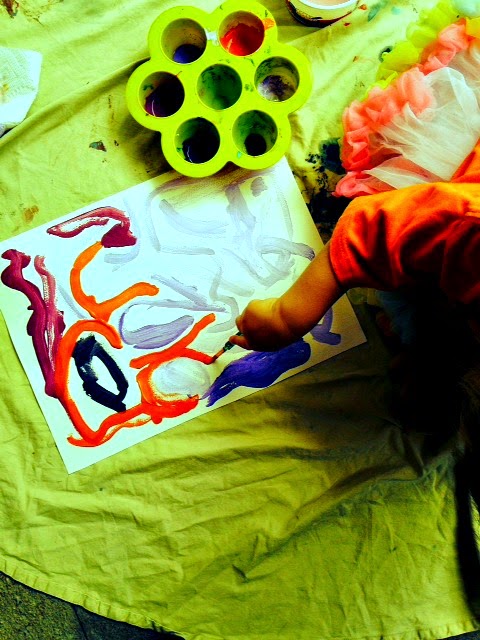
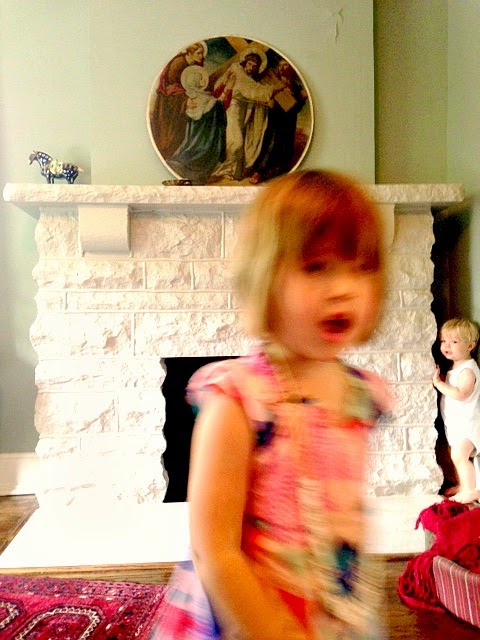
Four years ago today I went into labor, signed a contract on a house, watched an episode of Jeeves and Wooster (thank you Stephen Fry and Hugh Laurie), and then toodled over to the hospital to meet my first child. Harriet Paloma--I cannot believe you are Four. You are becoming a little lady, a good companion, an interesting conversationalist, an aid and support for your mother, a woman of character.


Remembering the first few weeks of your life, the first few weeks when I struggled to learn how to become a mother, I am in awe of who you are becoming. I am amazed at what you can do! You have reached the point where you are actually helpful! I told you so the other day. So we decided to compile a list in honor of the day: "Things Four-year-olds Can Do" ("all by myself," you added).

Things Four-Year-Olds Can Do (All By Myself)

1. Open the door for her mommy when her hands are full.
2. Listen to a chapter book.
3. Use the bathroom (almost) without help
4. Dress herself
5. Hold Mommy's coffee while she puts the baby in the car (so helpful!)
6. Obey Promptly
7. Set the Table
8. Keep the baby away from "choking hazards"


Sunday, September 7, 2014

House Update


There is progress on the house! Demolition is complete. All of the old (er, new) flooring has been removed and we can see the original tongue and groove which we will soon refinish. More importantly, the Cancerous Growth has been removed! We can now see the façade of the house as it was meant to be. Removal of said C.G. revealed the stone foundation, along with a corner-stone carved by hand with the initials of the original owner and the date, 1886. This is a later date than we were originally told, but after doing a bit of historical research we had begun to be suspicious of the veracity of the family lore handed down to us by the previous owner. Still, 1886 is old enough! And we were thrilled to uncover some history.

Anyway. Removing the addition has relieved the weird lopsided-ness of the house, but now we can see daylight through the wall where the kitchen will be. There was no salvageable siding under the plaster. So the front of the house must be sided pronto.

This has been a bit of an issue for us. We have opinions on siding. Our opinions being that wood, and only wood, is an acceptable material for siding a home. And real stone, and brick. I hate vinyl siding with a deep and abiding passion. However, we do not have the *ahem* resources to side the house with cedar lap at this time, and the house must be sided. So, we are going to use Smartside, which is a wood composite. I am terrified that I will hate it. And part of me feels like I have betrayed some deeply held principle. But there it is. It must be done. The siding goes up today.

Other than that: The new rooms are framed. We are plumbed. Devin will be putting in insulation in the next few weeks and then sheetrock!

We went up this weekend to “get some work done,” which really means mow. It was a pristine early September day (have I told you how much I love September?), but a frustrating trip because something is wrong with the mower. So Devin spent several unprofitable hours tinkering with the John Deere, while I hacked away at an old “flower” bed in preparation for a new perennial garden I hope to plant. I managed to save a bag full of iris tubers, but mainly succeeded in damaging my back as I hacked through a fierce web of mature weed roots. All in all I cleared out a little square about three feet by three feet. The bed runs for thirty feet along the road.


There is so much work to be done. It is so good for me. I am so tired.

Friday, August 15, 2014

What are People For?


In my last post I began by asking the question: “what is education for,” or, to say it a different way: “what is the end of education.” By the conclusion of the post, however, I determined that we cannot begin to answer this basic question until we have answered yet another, even more basic question, namely “what are people for?”  

Every educational system, every curriculum, answers this question, or rather works from some assumption (often unacknowledged) that answers this question. In the same way every human policy, every law, every political structure relies upon and implies some foundational philosophy: what is the meaning of life? Why are we here? Who are we?

We, as individuals, answer this question as well. Even if we have not explicitly acknowledged or addressed the question, we answer it with every act, every choice.

Many of us never stop to question the "answers" we give. We never explicitly ask ourselves “what am I FOR?” And many of us live easily from day to day, relying on the unspoken assumptions of our peer-groups and society. But when we begin to raise our children many of us stop short, shocked and confused, because, after all, we are meant to bring up these children to be…something. We have the responsibility to teach them…what? How can we “raise” them if we have no idea what heights they were made for? How can we “teach” them if we don’t know what they need to learn?

So. It must be answered.

What are people for? What makes us human?


It is an ancient question. Maybe the most ancient question. It has been answered in diverse times by saints and sinners, philosophers and bar-rats alike. And the answers have varied wildly. What makes us human? Language, free choice, a capacity for worship, our ability to make art: these are just a few characteristics that supposedly set us apart from the beasts. On the other hand, some suggest that nothing makes us human, that “humanity” itself is a meaningless category and there is no qualitative difference between a “human” and an “animal.” Perhaps, they argue, the difference is one of degree but not of kind.

I would, however, argue that such an argument falls flat to most men and women of what Chesterton would call “common sense.”

Certainly there has been great consensus throughout history: something sets humans apart from other forms of life on earth. St. Thomas calls us “rational animals,” because, if we are beasts, we are beasts capable of stepping outside of our animal nature and questioning it, we are able to define what “animal” means. We who exist within the material world are also able to discern order within the material world. Unlike animals we not only perceive phenomena, but we perceive relationship and causation within/between phenomena.

So far, so good. What else?


In his book Man’s Search for Meaning Victor Frankl writes this: 

   “being human always points, and is directed, to something or someone other than oneself—be it       a meaning to fulfill or another human being to encounter. The more one forgets himself—by           giving himself to a cause to serve or another person to love—the more human he is.” 

Here Frankl insists that human identity is not located in our ability to self-actualize, self-determine or “find ourselves,” but instead in our capacity to serve. 

Furthermore, the quote suggests that our humanity is not found in isolation, but in relation. We are defined by what—or who—we love. 

So the first definition points to our ability to perceive relation (between facts, within phenomena), while the second description points to our ability to be in relation (with our world, with each other).

But let’s go even further.


As a Christians we affirm that—if we are people at all—then we are people of relation, yes. But we believe furthermore that one original relationship initiates and sustains all these other relations: humanity’s relationship to God.

The Catechism tells us that humans were the only creatures that God “willed for [our] own sake,” and that we alone are “called to share, by knowledge and love, in God’s own life.”

I say it again: our identity is based in relationship, and a relationship first and foremost with a Person. I am awed to recall that this relationship is not just any relationship--not a contract, not a master/slave dialectic--but a relation of love, compared in scripture to human passion, romantic ecstasy. God calls us his “beloved.” He pursues each of us with yearning, calls to us:

     Arise, my beloved, my beautiful one, and come!
     O my dove in the clefts of the rock, in the secret recesses of the cliff,
     let me see you/let me hear your voice,
     for your voice is sweet,
     and you are lovely.

And we, the beloved, respond with desire and delight beyond words:

     Let him kiss me with the kisses of his mouth!
     More delightful is your love than wine!...Draw me!

The great mystic St. Catherine of Siena meditates on this mystery: “what made you establish man in so great a dignity?” she asks.

Certainly [it was] the incalculable love by which you have looked on your creature in yourself! You are taken with love for her; by love indeed you created her, by love you have given her a being capable of tasting your eternal Good.”  


We possess a being capable of tasting, yearning to taste, this eternal Good. And I am always further amazed that this “eternal Good”  is not some infinite yet impersonal force, but rather a Trinity

What does this mean? I am afraid that for many of us the term has become only a dry and technical theological term. But what the Trinity really means is this: when we seek deeply into the heart of reality we do not find (abstract) Power, Might, even Goodness, but a communion of persons, a community of love, and a family.

This is what the Catechism means when it says that the Trinity is “the mystery of God in himself” and “therefore the source of all other mysteries of faith, [as well as] the light that enlightens them.” It means that not only humans, but reality itself is relational, in relation—because the Creator himself is, in His own existence, in relation.  !!!

So what, after all this, is the final end of man? The Baltimore Catechism states it succinctly thus:
“The final end of man is to know, to love, and to serve God.”

This statement includes and explains both St. Thomas’s and Frankl’s descriptions of man: first, as one who perceives relation and second, as one who exists in relation. For to “know God” is to know him in the order he has made, and to “love and serve God” is to love and serve our neighbor.

And education? (Because that’s what we are supposedly talking about, right?) What should education do—in light of this conclusion?

Education, therefore, should support the student as she works to fulfill this threefold end:

To know God,
To love God,

To serve God.

Friday, August 1, 2014

THE END. Home School: Part Two


In my last post I asked a question:

What is education for? What is the end of education?

I find it interesting to read mission statements of various schools and educational bodies. Some of these statements are inspiring, illuminating even. Others leave me cold. The most recent Common Core Standards fall into the second category. I profess myself ignorant of the efficacy of their “means.” Whether or not their standards are rigorous, clear, enforceable, I do not know. But their ends seem suspect to my eye. “The standards,” we read, “are designed to ensure students are prepared for today’s entry-level careers, college courses, and workforce training programs.” The end of education (at least as far as they are concerned) seems to be a narrowly defined “success,” which itself is connected with ideas of productivity—specifically in an economically measurable form. It seems as if today’s children are viewed by their country and their educators as (potential) economic producers…and in some fundamental sense—products. 

I have nothing against vital careers or economic “success” per se. But—is this all? If education merely provides financial gain, the mere continuation the society and the physical comfort of the members of society, has it done its job?

Is standardization of knowledge, increased efficiency, heightened productivity what education is for?

Education is, by definition, the impartation of knowledge… But what kind of knowledge and to what end? And here I begin to suspect that the question “what is education for?” may not in fact be the best place to start either. Maybe, before we ask “what is education for,” maybe we should ask, like Wendell Berry “What are People For?”

Big question. But, I will argue, until we get a glimpse of what we are for how can we know what we should learn?

What people are for?

What makes us human?


*Aren't the grapes (pictured above) lovely? Alas, every *single* one was gone not three days after this photo was taken. Who is the culprit? We do not know.

Saturday, July 26, 2014

Home School: Part 1


...all images taken at the abandoned District 34 schoolhouse near Florence, Kansas.

This blog is, of course, intended to record the renovation of the house on Wise Road and showcase the “good life” we hope to lead in the country. But I also created this blog to serve as a space in which to explore the idea of home education.

Even before my daughter was born my husband and I contemplated the possibility of homeschooling our children. Over the years many things have attracted us to homeschooling: freedom, academic rigor, consistency, and flexibility, to name a few. But these are not the only or the best reasons to homeschool. Even as I type them I find them so vague/cursory/superficial as to be almost not worth listing. As I post here I hope to explore the deeper/more fundamental reasons that we are considering homeschooling for our family.

When we purchased the property on Wise Road we took the first definite step in the direction of home education, for if we spend half of our time in the country our children will not be attending traditional schools.
This decision has caused me not a little anxiety. For on top of the already daunting decision to take on a major home renovation, to add the work and responsibility of owning a second property, as well as the decision to live part of each week away from our beloved friends and family (not to mention away from our favorite coffee shops), there has been the additional burden of beginning a whole new project: the colossal responsibility of educating our children ourselves. You might be thinking that this in itself is the crowning example of our folly—more than our purchase of the disaster-I-mean-house on Wise Road. And you might be right. But over the years, as I have thought, read, and prayed (though that not nearly enough) I have grown to suspect that *for our family* this *might* be the wise road. Perhaps even the road to wisdom? 

Why? You may ask? Why should you homeschool? What’s wrong with public schools? What’s wrong with Catholic schools? What about socialization? What about your own weaknesses, foibles, preferences, political opinions, etc? Aren’t you just trying to create little mini-mes who reflect every opinion you hold? 

What if they become religious nuts?

Or worse... what if they become...weird?

What if you ruin your kids?

And believe me, these are questions that I have asked myself, will ask myself again. Perhaps, in the end, these questions will lead me back to traditional school, with all its legitimate joys and very real hardships. 

Perhaps.

But perhaps we won’t find out if the road we are on is the “wise road” or the way of folly—unless we walk down it.

And perhaps these questions are not even the right questions. Perhaps this is not the best way to begin a discussion on education, either for those considering home school or those contemplating which (more or less) traditional school to choose. In the following posts I will attempt to start at the beginning. But--where is the beginning?

Surely the first question we should ask is: what is the purpose of education? What is it for? What is it’s end? Surely we cannot answer the queries “which school?” “which curriculum?” until we have determined what school is for.

Stay tuned. 


Thursday, July 24, 2014

Gutted

Last week I went to Texas with both children. Devin planned on spending a night at Wise Road. We haven't done this yet; I have resisted. There is no air-conditioning. I know. Wimp I am.

But more than this, the house still didn't feel like "mine." Every time I walked through I felt ill at ease. It didn't smell right. Do you know what I mean? Not that it smelled bad. It didn't. It didn't smell of anything in particular. But still, it smelled...wrong.

In addition it didn't help that we had never been there alone. We had been there with real estate agents, contractors, neighbors, parents, and friends, but never just our family. I had never stood in the empty rooms and stared and thought and stared. It didn't feel like my house.

Anyway, this is all to say that we still hadn't spent a night at the house.  Devin headed out there after work one night, and was shocked to find, when he walked in the door, that the house was--gutted. Our contractors had begun work that day--a fantastic surprise since, you know, you never know what "we will begin work soon" really means in contractor-speak. I guess "soon" meant, like, that day. Awesome!


So Devin didn't spend the night after all. Which is A-OK!

When I returned from abroad we went up together to look things over and argue discuss ceilings, floors, bathtub placement etc. It was a wonderful day. Strangely, taking off the walls suddenly made this house "mine." I can see where things will be. I can imagine myself waking up in the morning and looking out *this* window at *that* field. There is a long way to go, but we are on the road!


Some complications have come to light as the layers have been pealed away. First, there is no insulation. Not a shocker considering the age of the house. But we need to go on and put that in. Our contractors quoted a price for that that seems...a bit ridiculous. So my intrepid spouse plans to do the insulation himself. We'll see how that goes.

The floors are the other issue. There are currently hardwoods throughout. They are okay: recently installed pre-finished tongue and groove. We had planned to salvage the flooring from the room we are demolishing and patch the parts of the floor that would be bare once we removed walls and tile etc. However, this is going to be a tricky (read *expensive*) job, and we are wondering if it might not be better/cheaper to remove all the hardwood and refinish the ORIGINAL FLOOR underneath. This is what I *really* want to do. We will see what state that floor is in soon enough. (Anybody have any experience with a similar job??)

"new" hardwood on left, original hardwoods peeking through the dust on the right.
Anyway, the unforeseens have already pushed Phase II back to next spring--that is residing the exterior. Still, I feel so much happier about the house already. We can live with the shabby exterior for a bit longer!

The weather last weekend was lovely. We took a hike through the fields and found the perfect tree-house tree. It was a good day.


Wednesday, July 9, 2014

Patriotism?


I must admit that patriotism has always baffled me. Sometimes it has even revolted me. The *feeling* of patriotism has never risen spontaneously in my breast, even as a youngster reciting the pledge of allegiance every morning before school began. The abstract concepts of “indivisibility” and “liberty” struck no chord, aroused no emotion. Even then, these ideas had little to do with my reality, made no reference to the smell of construction paper or the sound of chairs scraping the linoleum on the class-room floor, had nothing to do with the small loves, rivalries, sorrows of my childhood. They had nothing to do with the aroma and warmth of my home, my mother’s constant quiet happiness, her presence. Had nothing to do with pine-sap stuck to the heel of my hand.

I didn’t love my country—or didn’t think I did—until I lived in another country. Suddenly I felt an absence, I yearned for something, the “genius” of my homeland, for lack of a better word. And I was surprised to find that the “genius” was not, after all, the ideas that supposedly define our nation—not “life, liberty and the pursuit of happiness.” Not “freedom”—whatever that is. The “genius,” the enervating spirit of my country was, in reality, more like a local diety, a household god. Something mysterious, but most importantly local, concrete, related to the land, rooted in place and the particulars of place.

I was homesick. But I didn’t want “America”—if such a place exists. I wanted Wyandotte Road, I wanted the white pine in our back yard, whose habit and branches I knew. I wanted wheat-fields bleached in late June along I35. I wanted Strong City, Kansas. I wanted ash trees full of singing cardinals, dusty sparrows on the sidewalk in Brookside. I wanted cicadas droning in July. I wanted the faces of my parents and the rooms where I was a child.

As usual, Wendell Berry says it better:

In my teens, when I was away at school, I could comfort myself by recalling in intricate detail the fields I had worked and played in, and hunted over, and ridden through on horseback—and that were richly associated in my mind with people and with stories. I could recall even the casual locations of certain small rocks. I could recall the look of a hundred different kinds of daylight on all those places, the look of animals grazing over them, the postures and attitudes and movements of the men who worked in them, the quality of the grass and the crops that had grown on them. I had come to be aware of it as one is aware of one’s body; it was present to me whether I thought of it or not.

Patriotism, I think, must be this: this local love rooted and growing in a particular home, rather than an abstract idea imposed upon a place. This is the only way we can even begin to serve or even love our country, because it is, first and foremost, our mother and our home.

"When I have thought of the welfare of the earth," Berry writes,

the problems of its health and preservation, the care of its life, I have had this place before me, the part representing the whole more vividly and accurately, making clear and more pressing demands than any *idea* of the whole. When I have thought of kindness or cruelty, weariness or exuberance, devotion or betrayal, carelessness or care, doggedness or awkwardness or grace, I have had in my mind’s eye the men and women of this place, their faces and gestures and movements.


LinkWithin

A